
When setting out to explore new water there is always the critical question of where to start. It’s fun to explore, but it’s frustrating to walk six miles without seeing a fish. What we want to do is to roll up to a new place, walk to the water’s edge and say to ourselves, “now this place feels carpy.”
I received a nice email from a reader who suggested that I consider writing a longer, more detailed book about carp fishing that included information about how, when and where to find carp. This is a good suggestion and one that I take very seriously because I have been mulling this very idea over for some time. But before I get to a whole new book, I thought I would post a little bit about finding new places to try fly fishing for carp.
When I first started carp fishing I just picked spots on satellite images that looked shallow, but I soon learned that looks could be deceiving and realized that I needed additional knowledge to improve my ability to locate truly carpy spots. I consulted with one of my brothers who is a geology buff and he introduced me to fluvial geomorphology, the study of how the physical features of streams and rivers form and change. The good news is that this does allow one to better predict what an area will be like. The bad news is that the formation of these features can be very dynamic and not necessarily easy to predict. Here are a few examples:
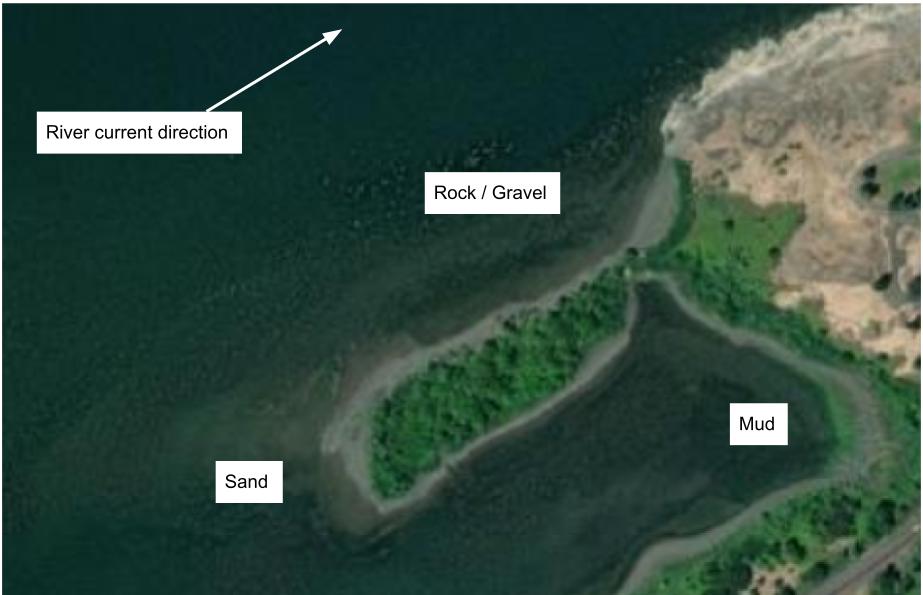
This river backwater demonstrates one principle of fluvial geomorphology. Higher current washes away or prevents small particles from settling on the bottom. In the picture, the outer edge of the point nearest the main river current is made up of larger particles, small rocks and gravel. In the small bay, away from the main current where the water gets trapped, those fine particles have a chance to settle out and the bottom is covered in a much finer dirt or mud. In the middle is something in between, more of a sandy bottom.
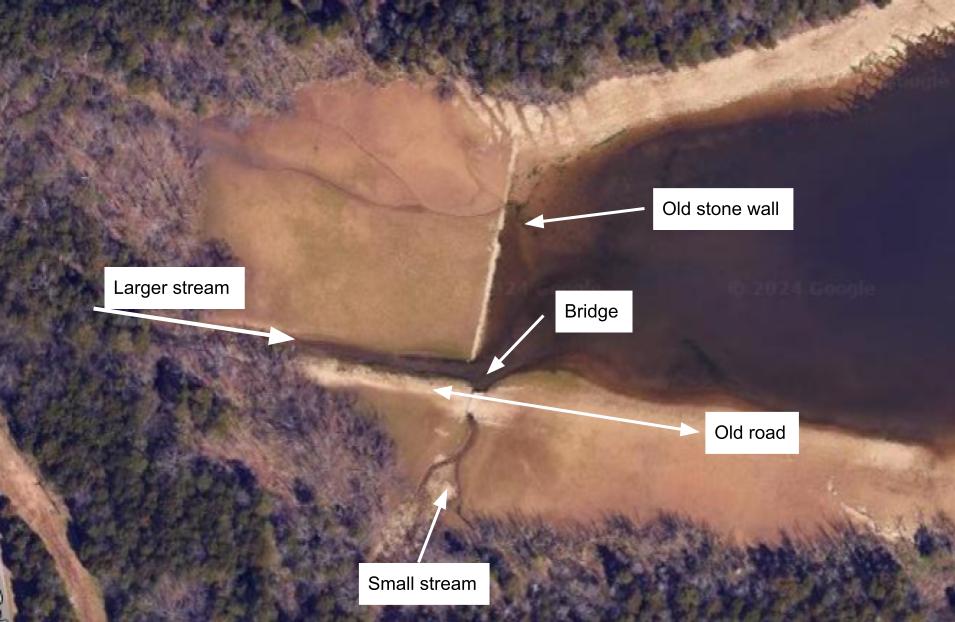
Above is another fairly straightforward example from a reservoir I used to fish at. Before the reservoir was filled this bay had a road with a short bridge. A low rock wall ran perpendicular to the road. Two streams intersected near the bridge, one small and the other a bit larger. When the reservoir was filled the roadway and wall helped trap sediment brought by the streams and that sediment formed shallow, silty flats. There was a third, very small stream flowing into the upper left hand corner of the larger flat. The carp especially liked to feed in the areas surrounding the three stream beds. My guess was that the bit of current brought some food items into the reservoir and helped promote the growth of plants and insects. Below is an image of the same area at higher water.
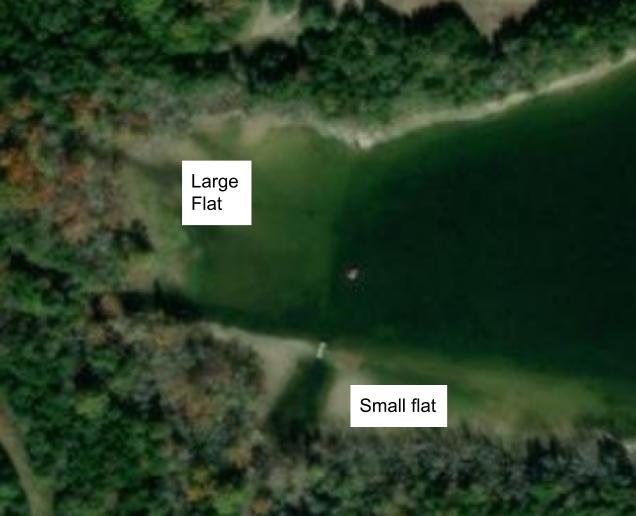
Then things can get a bit tricky to explain. Here is an example of a fairly large bay at the mouth of a small stream where it empties into a much larger river:

I guess that the sediment forming the flat came from the stream. Perhaps the stream current during flow events was strong enough to prevent the particles from settling too near the stream mouth, but the main river current created an eddy that allowed them to settle where they did? In any case, when I first visited this spot I was surprised at the size and depth of the deep pool at the back of the bay. In the summer the pool filled with weed and there were dozens of carp sunning themselves near the surface. Needless to say, they were not interested in eating. It took some patience but I did manage to find and hook two hungry fish, one moving into the bay from the main river, and the other probing the flat from the pool.
I still feel like I am just brushing the surface of this topic, and that a deeper dive will eventually assist me in more accurately finding new carp fishing spots. In addition to the physical formation of the shallows, I also think there is likely some powerful synergy with aquatic biology that might allow one to anticipate not just the formation of shallow areas, but which of those areas is most likely to hold an abundance of specific food items that would attract carp.
 The Fishing Dojo