
For many years I neglected fishing for bonefish in the surf zone. I did other types of fishing in the waves, but the huge movement of water and gnarly topography of the reef crest never really seemed like a good place to fly fish for bones. However, it turns out that, in the right spots and under the right conditions, the surf zone can be one of the most exciting places on the flat!
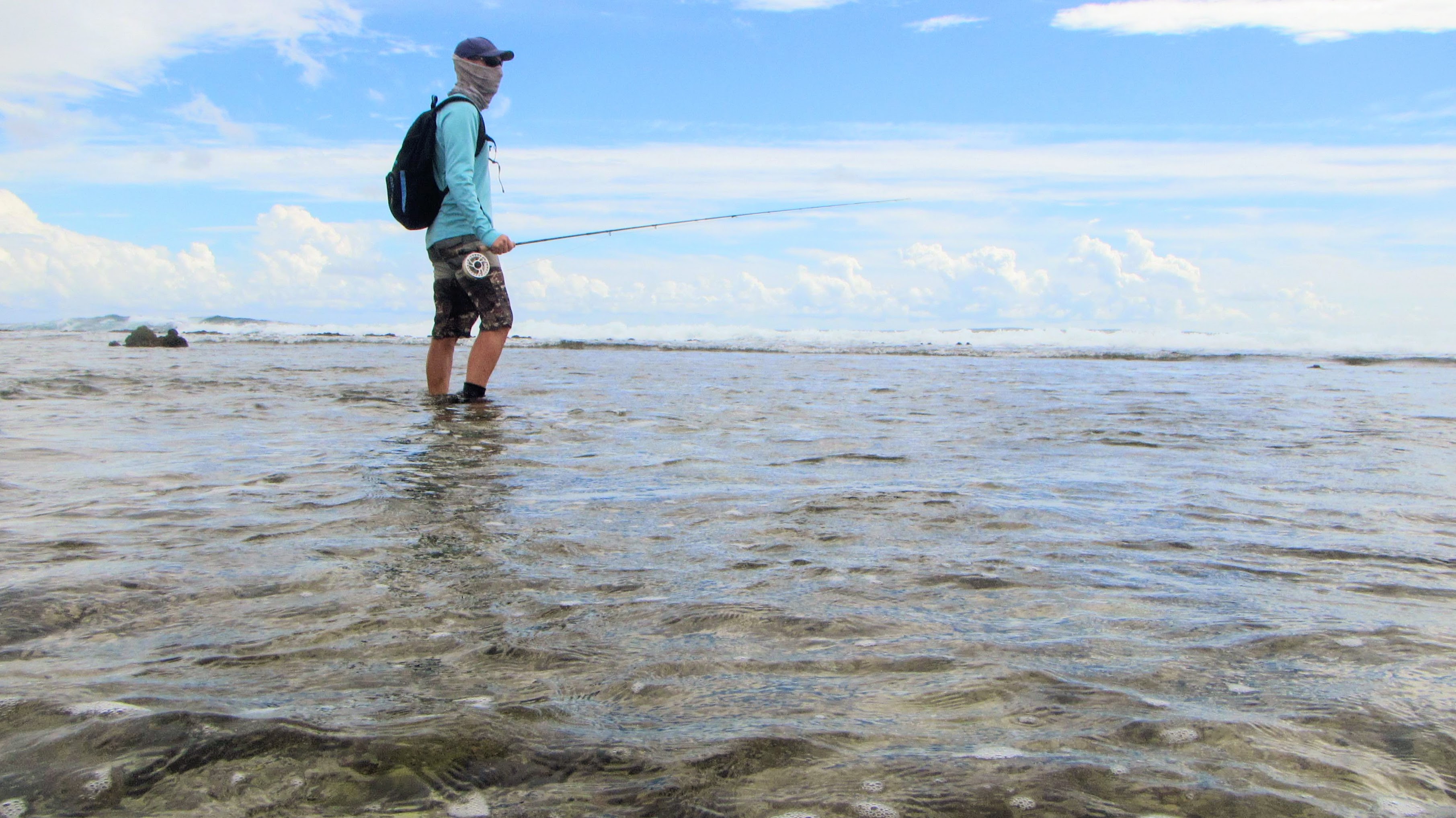
The “surf zone” is the outer part of a flat that faces the open ocean. Depending on the surf, tides, and reef formation, it can include the back reef, reef crest and even some of the fore reef. (For a nice description of coral reef anatomy, check out the CoRIS website, NOAA’s Coral Reef Information System.) Bonefish in this area are often hungry. They won’t spook quite as easily and will often take a fly more aggressively than fish higher on the flat. Here are a few things to think about if you decide to venture into the surf zone:
SAFETY
I don’t want to be alarmist, but it is always important to pay attention near waves. It is especially important to be cautious in a new or unfamiliar place. In addition to the surf itself, it is important to watch your footing in the surf zone. This part of the reef is prone to abrupt edges and sudden holes. In Hawaii, the surf zone is also home to the long-spined urchin, or wana (pronounced “vah-na”). These large, black urchins will easily pierce neoprene and their sting, while not super dangerous, is quite painful. Trust me.

HEAVY LINES
I usually bonefish with a 12 foot leader that tapers from 30 pound test to a 15 or 16 pound test tippet. But the surf zone is home to coral heads and rocky outcroppings that will destroy your leader (and your fly line). It’s exciting to hook a big, aggressive bonefish, but it’s a bummer to have it break off three and a half seconds later when it runs around a sharp rock. If I had to estimate, I would say that I have lost 90% of the bonefish that I have hooked in the surf zone using my usual leaders.
When I fish the surf zone, I prefer a 20 or even a 25 pound test tippet. Usually, I carry some pre-tied leaders for the surf, but you can also just trim off your tippet and fish a shorter leader that ends in a heavier line. The fish near the surf aren’t terribly leader-shy so you can usually get away with a nine foot leader. If I anticipate fighting fish in the rocks, I also prefer not to use a brand new fly line, because a decent size fish will turn it into $100 worth of string cheese.
HEAVY FLIES

Even small waves create a lot of water movement. Water from the flat also drains out through channels or cuts in the outer reef, which can cause substantial currents. For these reasons, I like to fish flies with larger, heavier eyes. It’s not enough to fish a fly with smaller eyes that has weight added in the form of lead wire (like the Spit Shrimp) because the water movement will still knock the fly over. Heavy eyes will get the fly down quickly, and ensure that it moves correctly along the bottom.
OTHER FISH IN THE SEA
There are other fish in the sea and the surf zone is one of my favorite places to look for them, especially when the clouds roll in and the bonefish are scarce. Large holes or cuts in the reef often hold smaller predatory fish, like wrasses, snappers, hawkfish, and groupers. To catch these fish I usually tie on a very small Crazy Charlie. These predators love to ambush small fish that get caught in the surf, so I usually wait for a small wave and then cast my fly over the spot and quickly strip it back through the foamy, churned-up whitewater.

The outer edge of the reef, and deep channels, can hold larger predators, like trevally. I always carry a few simple streamers in my fly box. They don’t have to be huge flies. Even big fish will stop for a small bait fish if it looks like an easy meal. If you are fishing directly into the surf, you can use the same strategy as for the smaller predators. Wait for a breaking wave and then cast out behind it and retrieve your fly through the whitewater. Remember to slow down the retrieve as your fly approaches the edge of the reef because that is the Omilu’s Strike Zone!
 The Fishing Dojo